The short answer
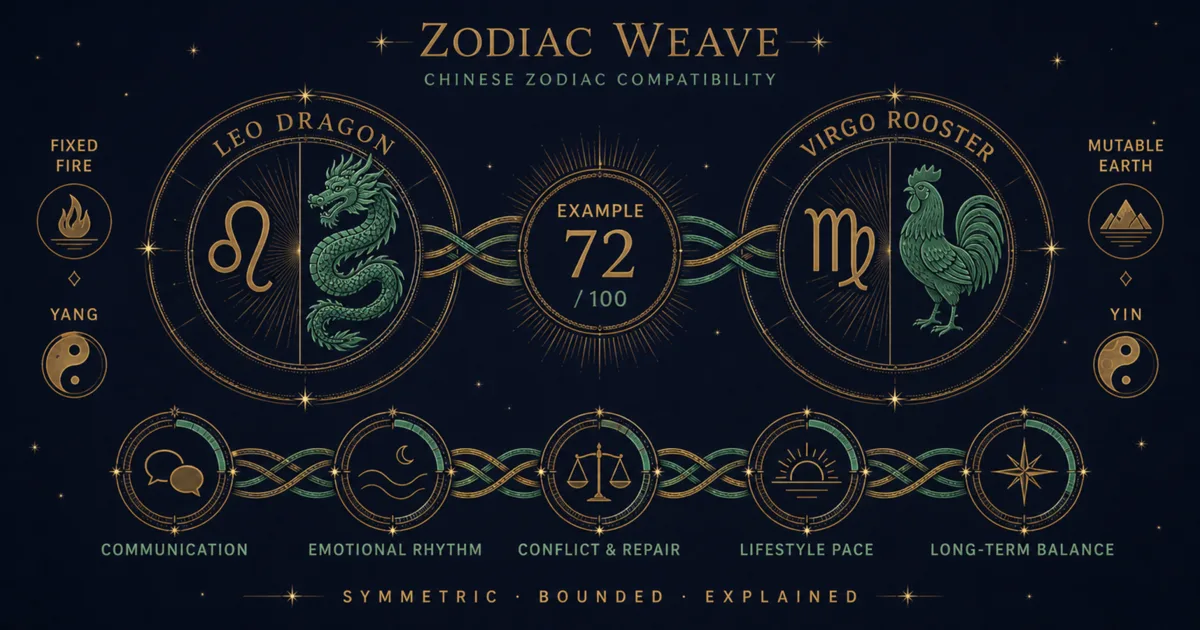
Enter two birth dates and Zodiac Weave returns one overall score, five dimension scores, and a plain-language explanation of each. The model weighs Western element pairs, Chinese zodiac animal bonds and tensions, Five Element year relationships, Yin–Yang polarity, and each person’s natural pace and style. The same two profiles always produce the same two numbers — the score has no direction, no luck, and no hidden weighting.
That design is the whole point. Compatibility scores on other sites often read like a verdict from the cosmos; here they are a discussion prompt. A low score names where two people will need deliberate translation. A high score names the channel that already feels easy. Neither decides anything about the relationship.
The five dimensions
Rather than one mysterious percentage, the tool separates the reading into five named dimensions, each with its own score and one-sentence rationale:
The overall score is a weighted blend of these five, and the dimension with the most room for growth is always labeled. You can see the exact weights and formulas in the compatibility model section of the methodology.
What the Chinese animal layer contributes
The animal layer is one input among several, but it is the one people usually ask about first. The model recognizes a few traditional markers from Chinese zodiac lore and weighs them as patterns, not prophecies:
- Same animal. Two people of the same animal share familiar instincts and mirrored blind spots — they understand each other quickly and may need help naming their shared assumptions.
- Same trine. Animals in the same traditional trine are scored as carrying complementary priorities.
- Six harmonies. The classic harmony pairs (Rat–Ox, Tiger–Pig, Rabbit–Dog, Dragon–Rooster, Snake–Monkey, Horse–Goat) are treated as ease markers.
- Clashes and harms. The traditional clash and harm pairs are treated as signals that pace, control, or unspoken assumptions need explicit negotiation — not as a verdict that the relationship cannot work.
Most pairings have no major animal marker at all, and the model says so instead of inventing drama. An unmarked pairing still has four other layers to consider. When a specific animal pair deserves a focused reading, it gets its own editorial page — see Rat and Snake compatibility (two planners on different clocks), Ox and Rabbit compatibility (same house, different blueprints), and Ox and Rooster compatibility (the finished room and the final detail). The next editorial set explores Snake and Dragon (strategy and momentum), Horse and Rooster(freedom and coordination), and Ox and Dragon(foundation and ambition).
The layers beyond the animal
A complete Zodiac Weave is never just an animal. The compatibility model also reads:
- Western element pairs. Fire, Earth, Air, and Water support each other in specific ways; identical or supporting elements score as smoother, while contrasting elements score as needing translation.
- Western modalities. Cardinal, Fixed, and Mutable expression styles affect who initiates, holds, or adapts — a recurring dynamic in the communication and conflict dimensions.
- Five Element year relationships. Each person’s year element follows the traditional generating and controlling cycles, which shape the long-term exchange.
- Yin–Yang polarity. Opposite polarities contribute a complementary rhythm; matching polarities a familiar one. Neither is better, only different.
- Pace and style. The combined traits of each full profile — tempo, expression, stability, and control — are compared directly.
If the layer definitions are unfamiliar, the Chinese vs Western zodiac guide explains how the two systems work, and the birth year table shows how a year becomes an animal plus an element plus a polarity.
Why the score is symmetric and bounded
The model compares a pair, so the result has no direction: person A compared with person B always equals person B compared with person A. That is a deliberate choice — the tool describes how two patterns interact, not how one person rates another.
Dimension scores stay within a bounded range, and the overall score falls into one of five bands with plain-language labels: Naturally reinforcing,Strong with useful differences, Promising with translation work, Mixed rhythms, workable by design, andHigh-contrast pairing. Each label is a starting point for discussion, not a report card.
What the tool deliberately leaves out
The honesty of the model comes from its limits. The calculator does not use birth time, houses, or planetary aspects, because it is not a natal chart. It also cannot see lived history, attachment style, values, communication skills, or the willingness to change — which matter far more than any zodiac layer. The how it workspage and the methodology state these limits explicitly instead of hiding them behind a plausible-looking score.
Born near a year boundary?
A January or February birthday can belong to the previous animal year, which changes the whole comparison. Check the Chinese zodiac boundary guide first, or let the calculator apply the correct boundary for you.
Common questions
Is this science?
No. It is an editorial reflection built on traditional zodiac symbolism and transparent scoring rules. It is entertainment and self-reflection, not a psychological assessment, a medical claim, or a prediction.
Do clashing animals mean a relationship is doomed?
No. A clash marker simply identifies where pace or control will need explicit negotiation. The scoreboard even reframes it: a lower score names a design problem, not a verdict.
Does it use birth time?
No — only the birth date. The Chinese year boundary is applied to the full date, and near the boundary the result carries a note rather than a guess.
What should I do with the result?
Use the dimension explanations as conversation starters. If emotional rhythm scores low, talk about how each of you processes distance and intensity. If communication scores high, build rituals around that ease. The strongest and weakest dimensions are labeled for exactly this reason.
How to use the tool
- Open the compatibility tool.
- Enter two birth dates, or start from two pre-filled profiles.
- Read the overall score, then the five dimensions and their explanations.
- Use the labeled strongest and weakest channels as discussion prompts.
The tool runs entirely in the browser. Shared results carry only derived signs, elements, and polarities — never birth dates — and every page keeps the entertainment and reflection disclaimer.
What this page is not
This page explains how a compatibility score is built and how to read it. It is not advice about whether to start, continue, or end a relationship, and it does not predict outcomes. Real relationships are shaped by behavior, context, and choice — the score is a mirror, not a map of the road ahead. For your own single-profile reading, start with the calculator.
How and why this guide was made
This guide was written against the same tested model the tool runs on, so every claim here matches an actual dimension, weight, or boundary in the code. It was reviewed to keep the language original and the framing honest: traditional zodiac markers are described as symbolic patterns, not scientific findings, and no percentage is presented as a prediction.