The direct answer
If you were born in January or February, do not assign your Chinese zodiac animal from the Gregorian year alone. First find the Lunar New Year date for your birth year. Under the civil Lunar New Year convention, a birthday before that date remains in the previous Chinese year; a birthday on or after it begins the new animal year.
Zodiac Weave uses Lunar New Year by default because it is the clearest civil-calendar rule. It also offers an optional Li Chun boundary for readers who follow that Chinese astrology convention. The selected method is shown in the result instead of being hidden.
If you were born in January
Do not automatically use the animal attached to the four-digit Gregorian year. Compare your full birth date with Lunar New Year for that year. If your January birthday came before the transition, use the preceding Chinese year, animal, element, and polarity. If it fell on or after Lunar New Year, use the new Chinese year.
If you were born in February
February can fall on either side of Lunar New Year, so the month alone is not enough. Check the exact day against that year’s transition. If a source changes the animal near February 4 instead, confirm that it is explicitly using Li Chun rather than the default Lunar New Year method.
A one-minute check
- Keep the full birth date, including the year.
- Find that year’s Lunar New Year date.
- If the birthday is earlier, use the preceding Chinese year and animal.
- If a source uses Li Chun, confirm that it labels the method and handles the exact boundary responsibly.
Why January 1 is the wrong boundary
The Chinese agricultural calendar is lunisolar: lunar months are coordinated with the solar year. Its first month does not begin on a fixed Gregorian date. Lunar New Year therefore moves through a window in late January and February.
The Hong Kong Observatory, an official calendar authority, describes the first day of the first lunar month as the start of the civil Chinese year. The same explanation distinguishes that year start from Li Chun, which marks the beginning of spring in the solar-term cycle.
January 1 belongs to the Gregorian calendar. It is useful for civil administration worldwide, but it does not automatically reset a traditional Chinese animal year. A calculator that simply applies the Gregorian year number will be wrong for every date between January 1 and Lunar New Year.
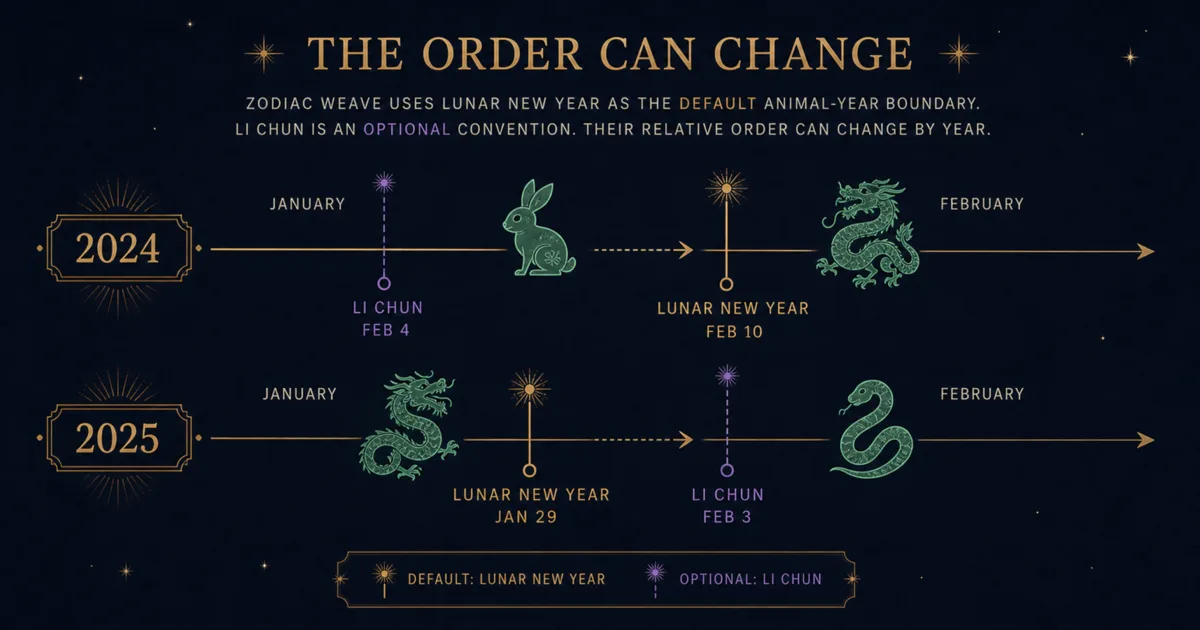
Recent examples: the date changes every year
These examples demonstrate why memorizing “February” is not enough. The transition can arrive in January or well into February.
Official Gregorian–lunar conversion tables are preferable to unsourced lists. The Hong Kong Observatory publishes year-by-year conversion material, and notes that astronomical data, calculation methods, and time standards can matter when a new moon occurs close to midnight.
Lunar New Year versus Li Chun
The two boundaries answer related but different calendar questions. Lunar New Year is the first day of the first lunar month and is widely used for the civil animal-year change. Li Chun is the Beginning of Spring, one of the twenty-four solar terms, usually occurring around February 4.
Some schools of Chinese astrology change the year stem and branch at Li Chun. That can produce a different animal or year element for a birthday between Li Chun and Lunar New Year—or between Lunar New Year and Li Chun when their order is reversed. A disagreement between two calculators may therefore be a method difference rather than a simple bug.
Zodiac Weave does not claim that one convention erases the other. It defaults to Lunar New Year, labels Li Chun as an alternative, and shows the chosen boundary in the result so the reader can understand why an answer was produced.
What happens at the exact transition?
A date-only calculator is appropriate for most birthdays, but an exact astronomical transition can be a time-and-location question. Civil dates are also interpreted within a time standard. That matters when an event falls close to midnight or when the birth location is far from the calendar authority’s reference zone.
For Lunar New Year, Zodiac Weave uses the civil date from its tested lunisolar conversion range. For Li Chun, it uses an estimated civil date normalized to China Standard Time and openly warns about the limitation. If a birth occurred very close to the precise Li Chun instant and the distinction matters to the reader, the honest answer is not false certainty: use the recorded birth time, location, and a specialist calculation.
The Hong Kong Observatory has documented how different astronomical datasets or time standards can occasionally produce a one-day discrepancy in a Gregorian–lunar conversion near midnight. That is another reason to prefer sourced calendar data over a copied year-animal table.
Why the correct year affects more than the animal
The Chinese year determines the animal, but it also determines the Heavenly Stem layer used for the Five Element and Yin–Yang polarity. If a birthday is assigned to the wrong year, all three outputs can shift together.
For example, February 9, 2024 belongs to the 2023 Chinese year under the Lunar New Year method: Rabbit, Water, and Yin. February 10 begins the 2024 Chinese year: Dragon, Wood, and Yang. This is not a cosmetic label change. It alters the entire Chinese-year side of a combined profile.
The Western sun sign usually remains unaffected by this particular boundary because it follows the month-and-day sun-sign range. A February birthday will generally be Aquarius or Pisces under the conventional tropical ranges, while its Chinese animal depends on the year transition.
Common wrong answers and how to spot them
“Everyone born in 2024 is a Dragon”
No. People born from January 1 through February 9, 2024 remain in the preceding Rabbit year under the Lunar New Year convention.
“The Chinese animal always changes on February 4”
That describes an approximate Li Chun convention, not the Lunar New Year rule. It should be labeled, and exact transition-hour claims require more than a date-only lookup.
“Lunar New Year is always in February”
No. It can occur in late January, as it did on January 22 in 2023 and January 29 in 2025.
“The birth year is enough”
It is enough only after the relevant year boundary has passed. January and February require the full date; exact Li Chun cases may also require time and location. For a fast year-by-year lookup, the Chinese zodiac by birth year table gives the animal, element, and polarity with the same boundary warning applied.
“Two different results prove the systems are random”
Sometimes one result is plainly using January 1 incorrectly. In other cases, the tools use different stated conventions. Compare the boundary labels before comparing the animal names.
How to verify your result on Zodiac Weave
- Enter the full birth date in the calculator.
- Leave “Lunar New Year” selected for the recommended civil-calendar result.
- Read the boundary note beside the Chinese animal, element, and polarity.
- If you intentionally follow Li Chun, select it and compare the result. Treat births close to the transition hour as needing additional evidence.
- Open the methodology if you want the supported date range and calculation limits.
The computation happens in your browser. Zodiac Weave does not store the birth date, and a shared result contains only derived signs, element, and polarity.
How this guide fits the two zodiac systems
The Chinese year boundary is only one half of a Chinese × Western combination. After the animal year is resolved, the birth month and day determine the Western sun sign. The two layers then form one of 144 base pairings.
If you want to understand the distinct cycles, element systems, and role of each layer before combining them, read Chinese vs Western zodiac differences. Keeping the systems separate at calculation time makes the combined interpretation clearer later.
How and why this guide was made
This page was created to solve a specific user problem: conflicting Chinese zodiac answers for January and February birthdays. Its examples were checked against Zodiac Weave’s calendar engine and official Hong Kong Observatory material. It states the default, names the alternative, and preserves uncertainty where a date-only result cannot support an exact-hour claim.
Zodiac Weave is an independent entertainment and reflection system. Astrology is not scientific evidence or professional advice. Do not use an animal year, element, polarity, or combination profile to make medical, legal, financial, hiring, safety, or relationship decisions.