The short answer
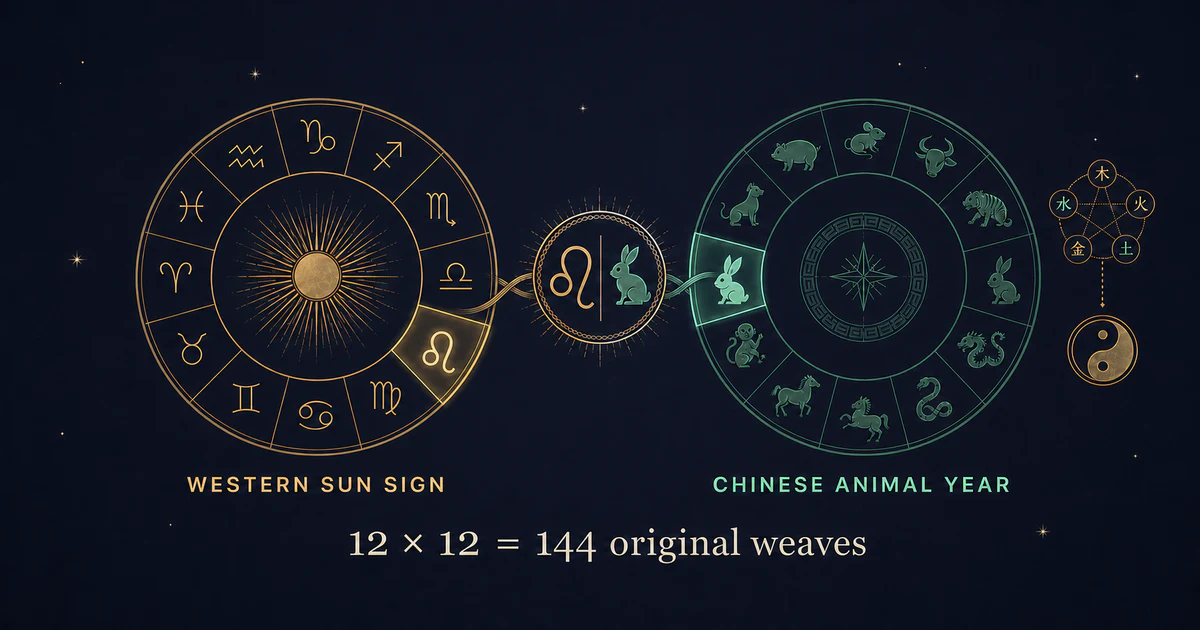
Western zodiac signs and Chinese zodiac animals are not two names for the same thing. In the common tropical Western system, the sun sign is assigned from a recurring month-and-day range within the Gregorian year. In the Chinese zodiac, the animal belongs to a repeating year cycle, and the year does not normally change on January 1.
That means two people born in the same Gregorian year may have different Chinese zodiac animals if one birthday falls before Lunar New Year. It also means people born eleven months apart can share the same Chinese animal while having very different Western sun signs.
If you encountered the category label elsewhere, the primal zodiac explainer describes what the combined approach means and where Zodiac Weave draws its independent editorial boundaries.
How the Western zodiac is calculated here
Zodiac Weave uses the familiar twelve tropical sun-sign date ranges. Aries begins around March 21, Taurus around April 20, and the sequence continues through Pisces. This produces one sign from the birth month and day. The year usually does not change that basic lookup.
This is a simplified sun-sign calculation, not a natal chart. It does not calculate the Moon, rising sign, houses, aspects, or exact planetary positions. A birthday on or next to a conventional sign boundary receives a note because the precise solar ingress can vary with year, time, and location.
The names of Western signs overlap with astronomical constellations, but an astrological sign range should not be confused with the modern boundaries of a constellation. A NASA/JPL education guide similarly distinguishes traditional astrological signs from the unequal astronomical constellations along the ecliptic.
How the Chinese zodiac is calculated here
The Chinese zodiac associates twelve animals with a repeating year cycle: Rat, Ox, Tiger, Rabbit, Dragon, Snake, Horse, Goat, Monkey, Rooster, Dog, and Pig. Historical examples of the established twelve-animal order appear in collections such as The Metropolitan Museum of Art.
The important calculation detail is the beginning of the year. Zodiac Weave defaults to Lunar New Year, the first day of the first lunar month. A January or February birthday before that date remains in the preceding Chinese animal year. The date moves from one Gregorian year to the next, so looking only at the four-digit birth year can be wrong.
Some Chinese astrology practices use Li Chun, the Beginning of Spring, instead. Zodiac Weave offers that as an explicitly labeled alternative. It uses an estimated civil date around February 4; a reading near the exact transition hour requires birth time, location, and a specialist ephemeris. The Hong Kong Observatory’s calendar explanation distinguishes Lunar New Year as the civil year start from Li Chun as the beginning of a season.
Why the Five Elements appear differently
Both traditions use the word “element,” but they are not interchangeable taxonomies. Western signs are commonly grouped into Fire, Earth, Air, and Water. These categories describe broad styles of drive, grounding, exchange, and feeling inside the Western system.
The Chinese year layer uses Wood, Fire, Earth, Metal, and Water. In the year cycle, these are connected to the ten Heavenly Stems, with each element appearing across a Yin and a Yang expression. Combining the ten-stem sequence with twelve Earthly Branches produces a sixty-year cycle.
A Fire-sign person is therefore not automatically born in a Fire-animal year. A Leo may be a Wood Dragon, Fire Dragon, Earth Dragon, Metal Dragon, or Water Dragon depending on the Chinese year. Zodiac Weave keeps those layers separate so one label does not silently replace another.
What each system contributes to a combined reading
A combined profile is most coherent when each layer has a defined job. Zodiac Weave treats the Western sign as a recurring expression pattern: its element, modality, pace, outward style, needs, strengths, and predictable overextensions. The Chinese animal adds a longer year rhythm: instinctive social strategy, appetite for risk, control style, loyalty pattern, and the way energy tends to consolidate.
The Chinese year element and Yin–Yang polarity then modify the animal pattern. They do not replace it. This makes a Leo Dragon and Leo Snake meaningfully different, while a Leo Dragon and Scorpio Dragon share a Chinese layer but express it through different Western structures.
The result is not “twice as accurate astrology.” It is an editorial framework with more than one symbolic lens. Its value comes from making tensions and reinforcements discussable. For example, a cautious animal pattern paired with an initiating Western sign can describe a person who starts quickly but reveals trust slowly. The point is the interaction, not a pile of flattering adjectives.
When two complete weaves are compared, the score can feel like a verdict — which is why the Chinese zodiac compatibility guide explains what the model weighs, why scores are symmetric and bounded, and what the tool deliberately leaves out.
Three examples of how combinations differ
Same Western sign, different Chinese animal
Leo Dragon combines fixed fire visibility with Dragon-scale ambition. A Leo Rabbit would retain warmth and creative identity but add a more diplomatic, atmosphere-sensitive animal rhythm. The Western layer stays constant; the social strategy changes.
Same Chinese animal, different Western sign
Leo Dragon and Cancer Dragon share the Dragon’s appetite for consequence and expansion. Leo tends to display that scale through public authorship, while Cancer may organize it around protection, belonging, and the creation of a durable inner domain. The same animal is not a duplicate personality.
The contrast is just as visible within Snake profiles: Gemini Snake brings rapid curiosity to a selective strategy, while Scorpio Snake pairs emotional depth with measured intelligence. Sharing one animal does not erase the Western sign’s pace or expression.
Same base pairing, different year element
Two Leo Dragons can share a base profile but differ at the year layer. Wood may emphasize growth and development; Metal may sharpen standards and resolve; Water may add adaptation and social perception. Actual behavior will still depend on culture, values, experience, and circumstance.
Common calculation mistakes
- Changing the Chinese animal on January 1. This is the most common error for January and February birthdays.
- Mixing Lunar New Year and Li Chun without saying so. Two calculators may disagree because they use different conventions, not because one performed the same calculation badly.
- Treating a sun sign as an astronomical natal chart. A month-and-day range cannot provide a rising sign, house system, or exact planetary aspects.
- Combining element names as though the traditions share one list. Western Air and Chinese Metal, for example, belong to different symbolic structures.
- Publishing 144 interchangeable summaries. A real combination page needs a unique tension, relationship pattern, work style, shadow, and growth direction.
How Zodiac Weave calculates a result
- Map the birth month and day to one conventional Western sun-sign range.
- Convert the full date across the selected Chinese year boundary—Lunar New Year by default or the labeled Li Chun estimate.
- Derive the Chinese animal, Five Element, and Yin–Yang year polarity.
- Join the two signs into one of 144 base combinations and show the additional year layers separately.
The calculation runs in the browser. Birth dates are not added to shared URLs. You can inspect the full boundary and compatibility rules in the methodology.
Have a January or February birthday?
Read the dedicated Chinese zodiac boundary guide before relying on a year-only lookup.
How and why this guide was made
This guide exists to prevent date mistakes and explain what the calculator does—not to manufacture another vague horoscope page. It was written against Zodiac Weave’s tested calculation rules, checked against official calendar material from the Hong Kong Observatory, and reviewed for the distinction between astrological signs and astronomical constellations.
Zodiac Weave is an independent editorial system. It is not affiliated with any astrology publisher. Astrology is not a scientific personality assessment, and this content is for entertainment and self-reflection. It should not be used for medical, legal, financial, hiring, safety, or relationship decisions.
Calculate my Chinese × Western zodiacBrowse all 144 combinations