The short answer
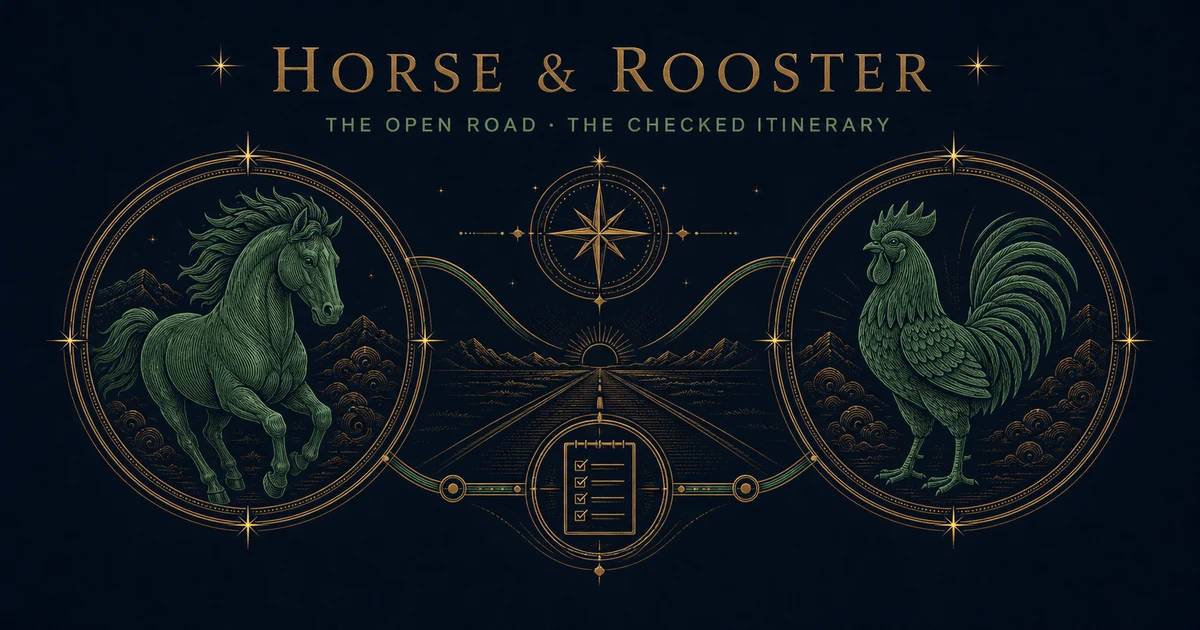
Horse and Rooster can enjoy the same Saturday and still tell opposite stories about why it worked. Horse remembers the unplanned beach stop, the person they met in line, and the restaurant they chose because the original place looked dull. Rooster remembers that the train times were checked, someone packed water, and the group knew where to meet after splitting up. Horse sees life in the detour. Rooster sees the structure that allowed the detour to remain fun.
This pairing is less about “spontaneous versus controlling” than about two definitions of freedom. Horse often feels free when options remain open and movement is possible. Rooster often feels free when expectations are clear enough that preventable mistakes will not own the day. If either person treats only their definition as legitimate, an ordinary schedule can become a referendum on trust.
Traditional Chinese zodiac frameworks do not give Horse and Rooster a simple harmony or clash verdict. That makes room for a grounded editorial reading. Astrology cannot determine whether people are considerate, safe, or suited to one another. It can offer a metaphor for a conversation: how much coordination lets both people improvise without making one person carry the consequences?
The open road: Horse
Horse energy often thinks while moving. It accepts an invitation, learns the neighborhood by walking it, and discovers what a project could become by making a first version. A rigid plan can feel less like safety and more like a room with no windows. Horse may be at its best when there is a clear direction, a meaningful challenge, and permission to adjust the route as reality becomes more interesting than the spreadsheet.
In relationships, that liveliness can be generous. Horse brings people together, suggests the outing nobody else would organize, and refuses to let a difficult week shrink the whole horizon. It can restore scale: this argument is not the entire friendship; this deadline is not the entire life. Its appetite for motion can help a careful person remember that joy is also useful information.
The difficult edge appears when flexibility is funded by somebody else's labor. A changed dinner plan may seem trivial to Horse while Rooster is the person updating reservations, allergies, transport, and the friend who already left home. “We'll figure it out” is not a neutral phrase if one person repeatedly becomes the figure-it-out department.
The checked itinerary: Rooster
Rooster energy often respects an experience by preparing it. It reads the instructions, notices that the museum closes early on Tuesdays, and asks the question that prevents a group from arriving with the wrong document. Details are not necessarily an attempt to drain delight from the day. They can be a way of making sure the delight reaches everyone, including the person with less time, money, mobility, or tolerance for uncertainty.
Rooster can also articulate a standard that others only sense. At work, it may be the person who turns “make it better” into a review checklist the team can actually use. In friendship, it remembers that a casual invitation sounded different to the person who traveled an hour. Clarity can protect dignity because people know what they are agreeing to.
The difficult edge appears when preparation becomes a constant correction of the present. Rooster can become so alert to the missed turn, late start, or imperfect choice that nobody feels allowed to enjoy what is still possible. Horse may then hide changes until the last moment simply to escape review, which gives Rooster more evidence that vigilance is needed.
Where the road and itinerary support each other
- A group trip. Rooster confirms the non-negotiables: the last train, the booking window, the shared budget, and how to reconnect. Horse protects an afternoon with no assigned attraction and notices the local festival that no planning guide mentioned.
- A creative launch. Horse gets the first version into motion and gives the work emotional energy. Rooster makes the promise legible, checks the handoff, and catches the detail that would make customers wonder whether the team can be trusted.
- A busy friendship. Rooster puts the next dinner on the calendar before another three months disappear. Horse makes the dinner feel like a real break rather than another obligation to complete efficiently.
Their strength is not a permanent division between entertainer and supervisor. Horse can handle real logistics; Rooster can welcome a change. The pair works when the itinerary protects the people and the open road protects the experience from becoming only logistics.
Where it grinds: a change versus a broken agreement
Horse may announce a change as new information: the weather improved, another friend can join, or the original plan no longer feels worth the time. Rooster may hear that a shared agreement has been treated as disposable. Rooster may respond by explaining every consequence in detail. Horse may hear a lecture instead of a practical constraint and push harder for freedom.
The conflict becomes personal when Rooster says, “You never think ahead,” or Horse says, “You ruin everything with rules.” Both claims erase the useful motive underneath. Horse is trying to remain responsive to life. Rooster is trying to ensure that responsiveness does not become unreliability.
- Time. “Around seven” may mean a loose social window to Horse and a real arrival agreement to Rooster. Use a range, name the hard boundary, and send an update before the other person has to ask.
- Money. Horse may pay for an unexpected experience; Rooster may be tracking the shared total. Decide what each person can spend freely and what needs a joint answer.
- Feedback. Rooster may offer a better method while Horse is still finding momentum. Ask whether the moment needs exploration, a safety check, or a final review.
Conflict and repair
A useful repair tool is the anchor-and-flex plan. The pair names two or three anchors that must hold — a departure time, a budget ceiling, a commitment to another person — and then makes everything else deliberately flexible. Horse receives genuine room to move. Rooster does not have to keep inventing rules because the important responsibilities are visible.
Changes need a full sentence: “I want to change this, here is what it affects, and here is what I will handle.” That last clause matters. It turns spontaneity from an idea someone else must administrate into an offer with ownership. Rooster can answer with the actual constraint rather than a history lesson: “The restaurant is flexible; the last train is not.”
After conflict, each person should name what the other was protecting. Horse can recognize that coordination made inclusion possible. Rooster can recognize that adaptation saved the day from a plan that no longer fit. This is not agreement about every choice; it is evidence that the other person's care has become visible again.
Work, friendship, and long-term patterns
In a work partnership, Horse may be strong at outreach, experimentation, live conversation, and making a stalled idea move. Rooster may be strong at quality control, positioning, documentation, and the promise the customer actually receives. In friendship, Horse expands the map while Rooster keeps the connection from depending entirely on chance. In a household, one may bring adventure while the other protects the calendar that lets everyone participate.
The long-term risk is parent-and-rebel role lock. Rooster becomes the person who asks, reminds, and disapproves; Horse becomes the person who delays, improvises, and escapes. That pattern is exhausting and unfair to both. Rotate ownership. Let Horse plan an experience from start to finish. Let Rooster choose one area where “good enough” is a real standard and practice receiving a surprise without conducting an audit.
What the year layer changes
This page reflects on the base Chinese-zodiac animals. A complete Zodiac Weave adds each person's birth-year element and Yin–Yang polarity, which may change how quickly someone acts, how directly they correct, or how much structure feels supportive. These symbolic layers are prompts, not measurements. See the methodology for the model and its limits.
Want the full weave comparison?
Use the compatibility tool to compare Western sign, Chinese animal, year element, and polarity. The Chinese zodiac compatibility guide explains why the score stays dimensional and reflective.
What this page is not
This page is for entertainment and reflection. It is not science, a diagnosis, professional advice, or a prediction of relationship success. A symbolic pairing cannot excuse broken promises or demand that anyone tolerate unsafe, controlling, or unfair behavior.
Find an animal and year layer in the birth year table, or browse the 144 Western × Chinese combinations. Continue with Ox and Rooster on standards,Snake and Dragon on strategy, or Ox and Dragon on foundations and ambition.