The short answer
The evening before friends come over, Ox has done the part nobody will notice unless it goes wrong: the shelves are level, the groceries are put away, the loose cabinet door finally closes, and there are enough chairs. Rooster walks through the room, sees the crooked picture frame and the pile of mail near the entry, and asks whether there is time to make the first impression feel finished. Ox can hear “nothing I did was enough.” Rooster can mean “we are so close to making this wonderful.”
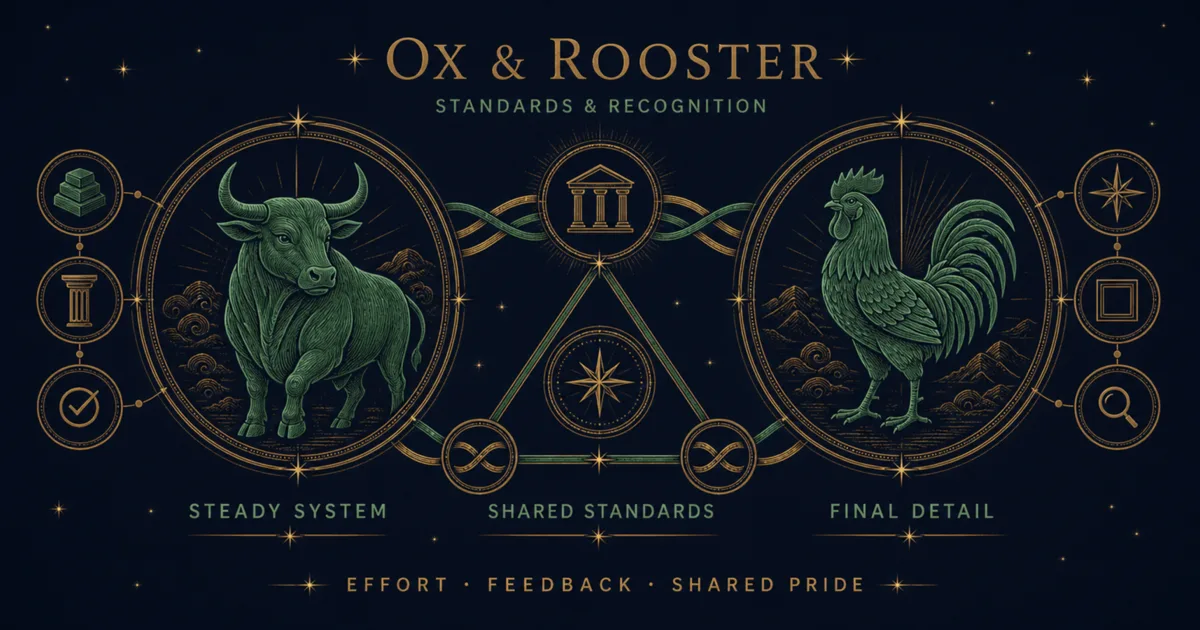
That small domestic scene captures the useful question in an Ox and Rooster reading. Both can care deeply about quality, responsibility, and the life they are building. Ox tends to trust what is durable, tested, and quietly completed. Rooster tends to trust a standard that is clear enough to see, name, and improve. Their friction is not usually a lack of effort. It is whether feedback lands as appreciation or as a running audit.
In Zodiac Weave’s editorial model, Ox and Rooster share a traditional trine. That is a starting point for reflection, not a promise about a relationship. A traditional marker cannot tell anyone whether two people listen well, divide labor fairly, or have compatible values. It simply gives this page a useful lens: two people may both value order while disagreeing about when something is truly done and how much praise should accompany the work.
The steady system: Ox
Ox energy is less interested in making a case than in making something hold. It can show care by arriving on time, following the agreed budget, finishing the unglamorous task, or keeping a promise after the excitement has worn off. In a shared apartment, that might mean handling the utility bill, measuring the furniture before ordering it, and remembering which drawer actually sticks. At work, it can look like building the process that lets a talented team meet a deadline twice, not just once.
That reliability has a quiet dignity. Ox may not narrate every effort because the completed result is meant to speak for itself. A repaired bike, a balanced spreadsheet, a booked appointment, or a carefully prepared meal can be its version of “I was thinking about us.” When others respond only to what still needs work, Ox can feel as though consistency has become invisible labor.
The shadow is not that Ox cares too much about responsibility. The trouble begins when endurance becomes a private test of worth. An Ox-leaning person may keep carrying the load, assume it is obvious how much is being done, and grow rigid when a late request changes the plan. What looks to someone else like resistance can be an attempt to protect a system that has already taken real effort to build.
The final detail: Rooster
Rooster energy notices the line that could be clearer, the room that could feel more welcoming, the sentence in a presentation that could make the whole idea land. It is not only interested in appearance. A polished invitation, a direct question, a well-timed introduction, or a better organized menu can be a way of respecting the people who will receive it. Rooster often sees that the final ten percent changes how the whole effort is understood.
Imagine a product team that has a functional launch ready by Thursday. Ox sees a real achievement: the work is stable, the deadline is met, and customers can use it. Rooster opens the homepage and spots a headline that confuses the value in the first sentence. To Rooster, raising that issue is a form of protection. A good product deserves to be understood, not merely shipped. To Ox, hearing that critique on Thursday evening can feel like the finish line just moved.
Rooster’s care can be articulate and exacting. It may praise openly, ask sharper questions than others will, and want the shared result to be something both people can stand behind. Its difficult edge appears when every observation arrives with the same urgency. If a small imperfection is treated like a moral failure, the person who did the work stops hearing useful information and starts defending their dignity instead.
Where their standards become shared pride
This pairing has a practical strength when each person recognizes the other’s contribution before claiming the whole project as their own.
- Moving in and hosting friends. Ox makes the new place functional: the lease details are understood, the lamp is assembled, and there is enough food for everyone. Rooster creates the welcome: a clear invitation, a table that feels considered, and introductions that make a new friend feel included. One person protects the foundation; the other helps people experience the warmth of it.
- A client-facing deadline. Ox builds the reliable version, checks the numbers, and makes sure the promised work is actually deliverable. Rooster tests the story: whether the proposal answers the client’s first question, whether the visual hierarchy is legible, and whether the team sounds confident when asked to explain a choice.
- A shared trip or event. Ox confirms the reservations and creates a schedule that will not collapse under minor changes. Rooster spots that the itinerary has no room for the restaurant everyone was excited about or the friend whose birthday matters. Ox keeps the day from becoming chaos; Rooster keeps it from feeling like an efficient errand.
The key is not assigning one person “boring work” and the other “beautiful work.” Both contribute to quality. Ox’s structure gives Rooster’s refinement something real to improve. Rooster’s eye helps Ox’s effort receive the clarity, credit, and welcome it deserves.
Where it grinds: feedback versus appreciation
The familiar conflict can begin with a simple sentence: “This is good, but…” If Rooster says that before acknowledging what has been completed, Ox may hear only the correction. If Ox answers with silence or a clipped “It works,” Rooster may hear that their perspective is unnecessary. Soon the argument is no longer about a slide deck, a table setting, or a travel plan. It is about whether care has been recognized.
- The last-minute adjustment. Rooster notices a detail shortly before a deadline and wants one more pass. Ox sees a change request after the work was already organized. The practical question is not who cares more; it is whether the improvement is essential now, useful later, or simply a preference that can wait.
- Public correction. Rooster may name a flaw quickly because clarity feels respectful. Ox may experience a correction in front of friends, colleagues, or family as a dismissal of the labor already given. A private conversation can preserve both honesty and dignity.
- The invisible completion. Ox may solve a problem before anyone sees it and then move on. Rooster may assume there was no problem because there is no visible story to praise. Without a habit of naming quiet effort, both people can feel underappreciated while sincerely believing they are carrying the relationship.
Conflict and repair
Useful repair for this pairing is concrete rather than ceremonial. Before suggesting a change, name the completed value: “The plan is clear and you got us here on time. I have one detail that might make the handoff easier.” This is not empty praise. It tells Ox that the work itself has registered.
A shared project also benefits from an explicit moment when feedback is welcome and another when the decision is closed. Rooster gets a real lane for refinement; Ox gets protection from an endlessly moving finish line. “Good enough for tonight” and “the version we want people to remember” are different standards. Naming which one applies prevents a small improvement from becoming a fight about character.
Specific recognition is more believable than a generic compliment. Ox can say, “You made the whole room feel considered.” Rooster can say, “You made this possible before anyone even walked in.” The point is not to turn every household task or team review into a ritual. It is to prevent high standards from becoming a code for “you are not enough.”
Work, friendship, and long-term patterns
Ox and Rooster do not need to be romantic partners for this lens to be useful. In a friendship, one person may be the reliable organizer while the other makes sure a birthday, presentation, or shared plan feels intentional. In a creative or operational partnership, Ox can protect repeatability while Rooster protects the quality of the public-facing result. In a family, they may be the two people who keep a gathering both functional and memorable.
The long-term risk is role lock. If Ox is always expected to carry the boring weight, resentment can harden behind competence. If Rooster is always expected to judge the final result, they can become anxious, critical, or over-responsible for everyone’s impression. Both roles need rotation and acknowledgment. The person who sees the standard should sometimes carry a piece of the work. The person who carries the work should sometimes say what they want the result to feel like.
What the year layer changes
This page discusses only the base Chinese-zodiac animal pattern. A complete Zodiac Weave also includes a birth-year element and Yin–Yang polarity, which can shift how each person expresses a need for order, praise, change, or control. Similar element patterns may make the pair’s habits feel more familiar. Generating and controlling element relationships can make the same habits feel more supportive or more demanding. Those layers are prompts for a fuller conversation, not a reason to overrule lived experience. The methodology documents how Zodiac Weave derives and weighs those layers.
Want the full weave comparison?
This page reflects on two Chinese zodiac animals. To compare two complete Zodiac Weaves — Western sign, Chinese animal, year element, and polarity together — use the compatibility tool. The Chinese zodiac compatibility guideexplains what each dimension can and cannot say.
What this page is not
This is an editorial reflection on two Chinese zodiac animals, written through everyday situations such as moving, work launches, shared plans, and hosting friends. It is not science, a personality diagnosis, or a prediction about whether any friendship, family relationship, or romance will work. No animal pairing can substitute for consent, fairness, communication, or real knowledge of another person.
The 144-combination directory covers every Western sign × Chinese animal pairing, while the birth year table confirms an animal, element, and polarity first. For other focused animal-pair reflections, read Rat and Snake compatibilityon timing and disclosure, or Ox and Rabbit compatibility on work, warmth, and the same house.Horse and Rooster compatibility explores how clear coordination can preserve an open road.